Claire Epps
Soldiers and civilians dealt with illness commonly throughout the years, but none were as deadly as the Spanish Influenza disease that swept the trenches and the world during WWI. This deadly illness took hold as WWI was ending and killed an estimated 50 million people globally. It went on to kill almost three times more people than the 17 million soldiers and civilians killed during during the war. The pandemic of occurred in three waves. The first wave occurred when mild influenza erupted in the late spring and summer of 1918. The second wave occurred with an outbreak of severe influenza in the fall of 1918 and the final wave occurred in the spring of 1919.
Within months, Spanish Flu had killed more people than any other illness in recorded history. It struck fast and was indiscriminate. In just one year, the average life expectancy in America dropped by 12 years according to the US National Archives. But there was a preventable reason as to why the outbreak was so deadly. As of 1918, Influenza was not a reported disease. However, in March of that year, the Public Health Service began getting reports of the disease in Kansas, then in May, more reports came from Europe.
Within two months, the disease had spread from the military to the public population in Europe. From there, the disease spread outward—to Asia, Africa, South America and, back again, to North America. However, not everyone knew what it was or why they were getting sick. In fact, the main reason why the illness killed so many people was the lack of public communication about it. Even today, dangerous diseases only reach the headlines if there is a risk of a pandemic, like the current Ebola outbreak. Other than that they are the largely ignored global killers, but every year they kill more people than wars and other military conflicts. After much protest, an organization was finally put in place.
On September 21, 1918, word finally reached the public in Washington. The Washington Times published an article about the disease saying, “Outbreak of ‘Spanish’ Influenza among Washington’s civilian population was revealed today when the first fatal case had been reported to the District Health office.” However, by this time, World War I had left many communities with a shortage of trained medical personnel. As influenza spread, local officials urgently requested the Public Health Service to send nurses and doctors. With less than 700 officers on duty, the Public Health Service was unable to meet most of these requests. On the rare occasions when the Public Health Service was able to send physicians and nurses, they often became ill in route. Those who did reach their destination safely often found themselves both unprepared and unable to provide real assistance. Also confronted with a shortage of hospital beds, many local officials ordered that community centers and local schools be transformed into emergency hospitals.
On September 21, 1918, word finally reached the public in Washington. The Washington Times published an article about the disease saying, “Outbreak of ‘Spanish’ Influenza among Washington’s civilian population was revealed today when the first fatal case had been reported to the District Health office.” However, by this time, World War I had left many communities with a shortage of trained medical personnel. As influenza spread, local officials urgently requested the Public Health Service to send nurses and doctors. With less than 700 officers on duty, the Public Health Service was unable to meet most of these requests. On the rare occasions when the Public Health Service was able to send physicians and nurses, they often became ill in route. Those who did reach their destination safely often found themselves both unprepared and unable to provide real assistance. Also confronted with a shortage of hospital beds, many local officials ordered that community centers and local schools be transformed into emergency hospitals.
Responding to the Spanish Influenza, The League was set up. Listed in the organization’s founding treaty was the matter of prevention and control of disease. Very quickly, drawing lessons from the Spanish Flu and other global diseases, the League would lay the foundations of our modern system of global healthcare control. Although originally the public was relatively unaware of the pandemic, federal, state and local authorities quickly drew resources to fight the disease. On September 27th, influenza became a reportable disease. However, influenza had become so widespread by that time that most states were unable to keep accurate records. Many simply failed to report to the Public Health Service during the pandemic, leaving epidemiologists to guess at the impact the disease may have had in different areas.
Recent analyses of non-pharmaceutical interventions during 1918 indicate cities in which multiple interventions were implemented early in the pandemic fared better. In reviewing this history, our country and the world has learned how to better cope with diseases as influential as this one. It is most important to engage in developing a plan ahead of time that incorporates all levels of the government health department in order to provide the military and common man with ideal health care so we will not have to worry about an outbreak such like the Spanish Influenza.
Soldiers from Fort Riley, Kansas ill with Spanish Influenza
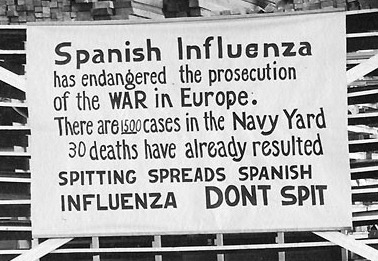
A protesting sign set up outside of a Navy hospital base.

Members of the Red Cross take away bodies in St. Louis

Patients in a U.S Naval center

Cities digging mass graves
